Este artículo aún no está disponible en tu idioma. Mostramos la versión en inglés.
Should Your Brand Create Multiple Instagram Accounts? A Decision Framework
Use this practical framework to decide when a brand should create multiple Instagram accounts and how to operate them with isolated cloud phones and clear ownership.
A growing brand often reaches a point where one Instagram account feels crowded. The feed serves several product lines, audiences, languages, or business units. Customers ask questions that apply only to one category. Regional campaigns compete for space. Internal teams begin requesting their own channels.
Creating another account can make the brand more relevant, but it also creates another content calendar, inbox, login session, publishing schedule, and access list. A weak second account may divide attention without building a useful audience. A well-designed account can give a distinct community the content and service it actually needs.
The right question is therefore not, “Can we open another Instagram profile?” It is, “Does this audience need an independent experience, and can we operate it consistently?” This framework helps brands answer that question before adding account complexity.
The Strongest Reason to Split: A Different Audience Promise
Every Instagram account makes an implicit promise about who it serves and what followers will receive. If two audiences expect substantially different content, products, languages, or customer support, separate accounts may be justified.
A sportswear company, for example, may sell performance running gear and fashion-focused streetwear. If the same customers follow both categories and the brand story connects them, one account can work. If the audiences, creators, campaigns, and buying motivations are different, separate accounts may produce clearer positioning.
Before splitting, write one sentence for each proposed account:
- This account is for [specific audience].
- It helps them [specific outcome].
- It publishes [specific content categories].
- It is owned by [specific team or person].
If two proposed accounts produce nearly identical answers, the brand probably has a content-planning problem rather than a need for another profile.
Five Questions to Answer Before Creating Another Account
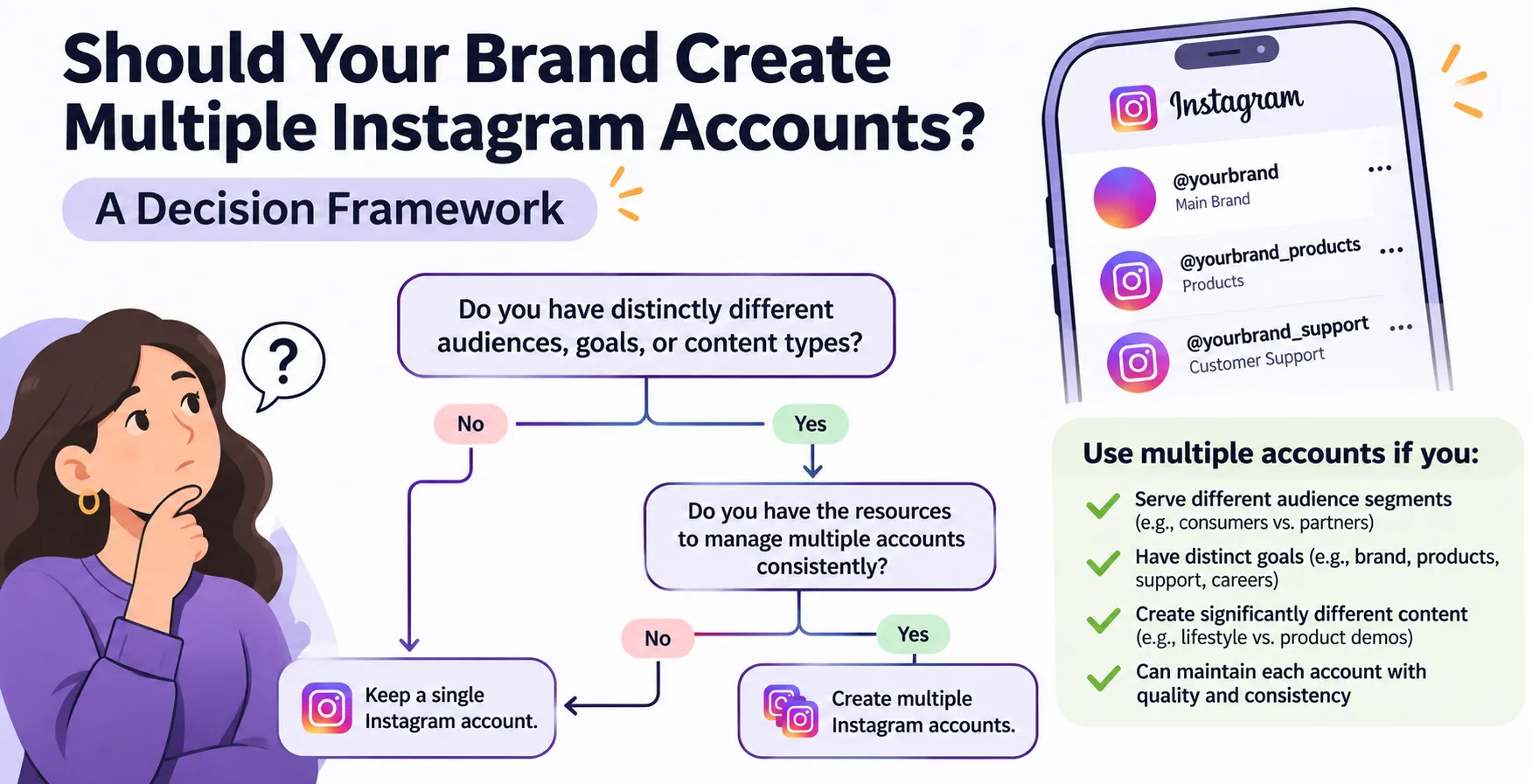
1. Is the audience meaningfully different?
A different age group alone is not enough. Look for differences in language, product need, purchase journey, cultural context, creator ecosystem, or support expectations. The new account should make it easier to deliver relevance that the main account cannot provide consistently.
2. Is there enough original content?
A separate profile needs more than occasional reposts from the main feed. The team should be able to sustain its own Reels, Stories, product education, community features, creator content, and campaign moments. If most posts will be duplicated, followers gain little from the split.
3. Does the account have a commercial or service purpose?
Define what success means. The objective might be qualified traffic, product discovery, local store visits, creator recruitment, community support, or customer service. “More followers” is too vague to justify a new operating unit.
4. Is there a named owner with enough capacity?
An account without ownership becomes a neglected brand surface. Assign a primary operator, backup operator, content approver, inbox owner, and escalation contact. Estimate the weekly work required for planning, production, publishing, engagement, reporting, and access management.
5. Can the brand keep the accounts operationally separate?
Separate profiles should have clearly labeled environments, approved assets, login recovery procedures, and access assignments. If employees must guess which phone, caption, proxy, or account is active, the split creates avoidable risk.
When One Instagram Account Is Usually Better
Brands should resist splitting when the audiences overlap heavily, content resources are limited, or the proposed account exists only because an internal department wants its own channel. One strong account can concentrate reach, social proof, and creative effort.
Keep one account when:
- The same customers buy across the product categories.
- The brand voice and content themes remain consistent.
- The new profile would mostly repost existing content.
- No team member can own publishing and community management.
- Customers would be confused about which account to follow or contact.
- The goal can be achieved with Highlights, content series, broadcast channels, or clearer editorial planning.
A brand can still segment content inside one profile through recurring formats, creator series, product collections, and audience-specific landing pages. Account separation should solve a structural problem, not compensate for an inconsistent calendar.
Three Situations Where Multiple Accounts Make Sense
Different product communities
A consumer electronics company may operate a main corporate account, a gaming account, and a professional-creator account. Each community follows different product launches, tutorials, creators, and support topics. The account names and bios should make the relationship between the profiles clear.
Distinct customer journeys
A fitness company might separate consumer memberships from instructor recruitment. One account focuses on workouts, member stories, and subscriptions; the other publishes certification information, teaching resources, and career opportunities. Combining both journeys could make the feed less useful to each audience.
Brand and creator or affiliate operations
An e-commerce brand may keep its customer-facing account separate from a creator-community account used for briefs, campaign education, and affiliate recruitment. The second profile has a different inbox workflow and should be operated by the partnerships team rather than general customer support.
Run a 90-Day Pilot Before Scaling
Instead of launching several profiles at once, start with one additional account and define a 90-day pilot. The pilot should include a content commitment, staffing plan, publishing cadence, inbox coverage, and measurable business goal.
During the pilot, track:
- Publishing consistency and percentage of planned posts completed.
- Engagement from the intended audience rather than total engagement alone.
- Qualified website visits, leads, inquiries, or sales connected to the account’s purpose.
- Direct-message volume, response time, and escalation rate.
- Time spent creating content that cannot be reused elsewhere.
- Operational mistakes, access issues, and verification interruptions.
At the end of the pilot, decide whether to continue, merge the account back into the main profile, or revise the audience promise. Closing an unproductive experiment is better than maintaining a permanent inactive account.
Build the Operating Environment Before Launch Day
Once the strategic case is clear, the brand needs a reliable workspace. MoreLogin Cloud Phone can place each Instagram account in a separate Android environment with its own app data, login session, device settings, and proxy configuration. Teams can use Instagram’s native app without depending on a collection of employee-owned phones.
For brands ready to create multiple Instagram accounts, the MoreLogin scenario page explains how isolated cloud phones, automation, and team access support the workflow.
A practical environment name should identify the brand, account purpose, market, and owner. Groups can separate customer-facing profiles, creator communities, product lines, and pilot accounts. Recovery contacts, asset folders, publishing calendars, and escalation rules should be recorded before the first post.
Assign Access According to the Account’s Purpose
A product-line publisher does not automatically need access to a creator account. A partnerships specialist may need the creator inbox but not the main store profile. MoreLogin allows managers to assign selected cloud phone environments to the appropriate members while restricting passwords, cookies, and other sensitive information.
This matters during onboarding, role changes, and offboarding. The Instagram session remains in the company-controlled environment, while managers update who can operate it. A backup owner can continue the work without asking the previous employee to transfer a personal device or send credentials through chat.
Use Automation Only After the Content Model Works
Synchronizer, RPA, and AI Automation can reduce repetitive steps across selected cloud phones. Teams may use them to support approved publishing sequences, scheduled tasks, account-specific inputs, or content workflows. Automation is most valuable after the brand has defined what each account should publish and who approves it.
Avoid turning separate accounts into identical copies. Each profile needs its own audience logic, caption, asset selection, timing, and destination. Automation should not be used for spam, fake engagement, impersonation, or behavior that violates Instagram’s terms.
Common Reasons Multi-Account Strategies Fail
- The brand launches accounts faster than it can produce differentiated content.
- No one owns comments, DMs, or customer escalations.
- Employees use personal phones and keep business sessions after role changes.
- Several profiles publish the same content with no clear audience benefit.
- Success is measured only by follower count instead of the account’s business purpose.
- The organization treats a new account as a campaign asset rather than an ongoing operating responsibility.
These failures are not primarily technical. They come from weak positioning, insufficient resources, and unclear accountability. Technology can make the accounts easier to operate, but it cannot create a meaningful reason for them to exist.
Create a Portfolio of Accounts, Not a Collection of Logins
Multiple Instagram accounts can help a brand serve distinct communities, product lines, and business journeys. They can also fragment attention and create unnecessary work. The difference is whether every account has a clear audience promise, original content supply, commercial purpose, and accountable owner.
MoreLogin provides the mobile infrastructure for teams that have made that strategic decision. Isolated cloud phones keep app data and sessions organized, team assignments support controlled collaboration, and automation tools reduce defined repetitive work.
The smartest multi-account strategy begins before any profile is created: prove that the audience needs a separate experience, confirm the team can sustain it, and build an operating environment that remains clear as the account grows.