この記事はまだお使いの言語で提供されていません。英語版を表示します。
Best Website to Sell Handmade Items When Craft-Fair Buyers Come Back for More
Compare the 11 best websites to sell handmade items across owned storefronts and craft marketplaces, from chat-built stores to Etsy and wholesale reorders.
Shoppers leaving your craft booth often ask, “Do you have a website?” That one question splits buyers into two camps: first-time visitors who need marketplace proof, and warm fans who just want a quick, branded checkout. The simplest fix is to run one home base you personally control plus one discovery channel for strangers. The guide below puts that plan to the test across the 11 best websites to sell handmade items.
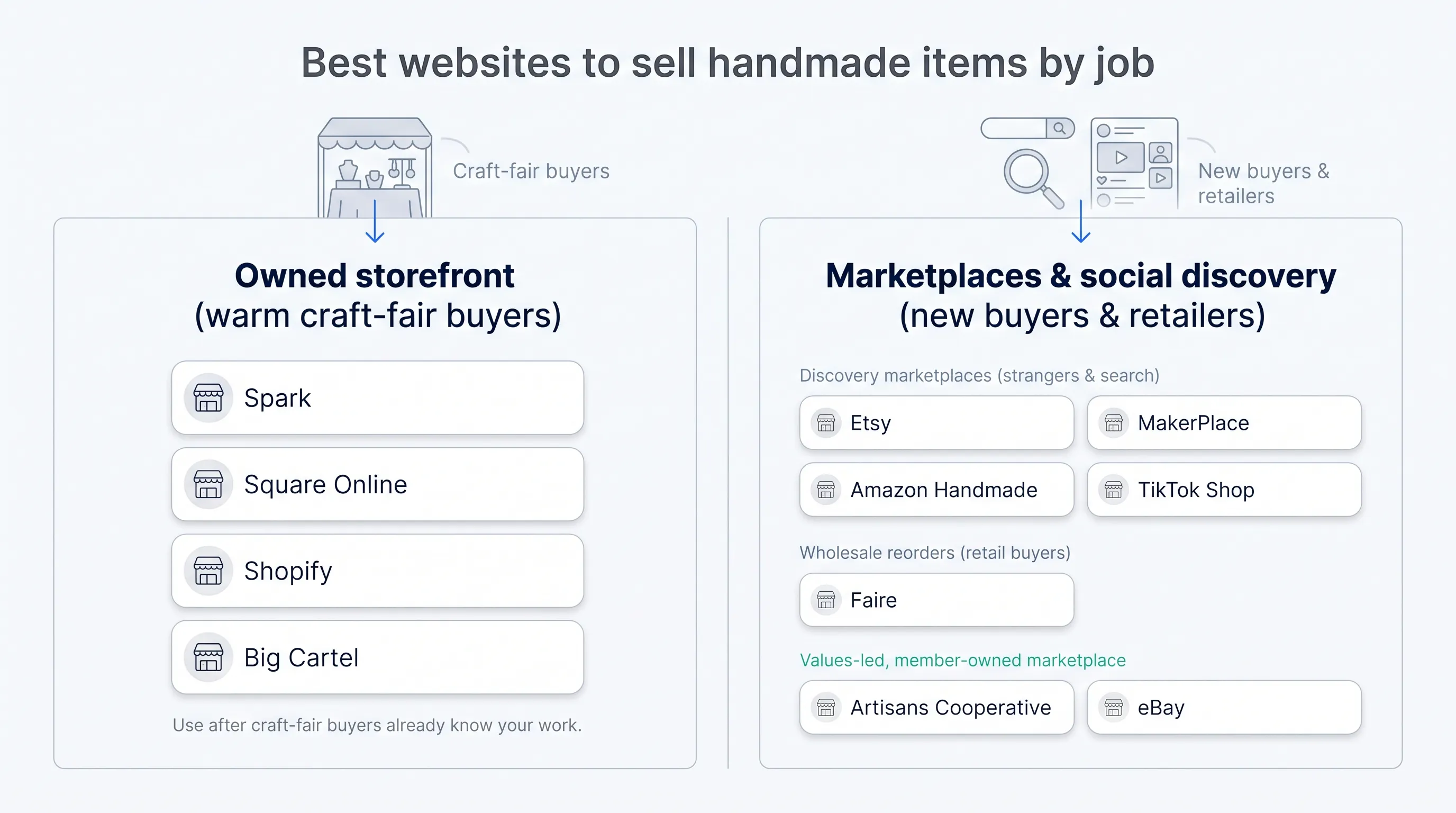
Quick answer: best handmade-selling websites by job.
Fastest takeaway: The best website to sell handmade items depends on where the buyer meets you: use one owned storefront for warm craft-fair fans and one marketplace or social channel for strangers.
| Platform | Best for | Built-in shoppers? | Starting cost | Typical selling fee* | POS fit | Biggest drawback |
|---|---|---|---|---|---|---|
| Spark | One-page direct store built in chat | No | Free to build and publish; payments from $25 per month | 10 percent (Starter) or 5 percent (Pro) + Stripe | Online checkout via Stripe | No marketplace traffic |
| Square Online | Booth-to-web with the same catalog | No | $0 | 3.3 percent + 30 ¢ | Square POS | Automated campaigns need a paid plan |
| Shopify | Scaling a maker brand | No | $29 per month (annual billing) | 2.9 percent + 30 ¢ | Shopify POS | App costs add up |
| Big Cartel | Tiny art catalogs | No | $0 | Stripe or PayPal only | Phone-based in-person sales | Abandoned-cart recovery only on Diamond |
| Etsy | Handmade search demand | Yes | $0.20 per listing | 6.5 percent + about 3 percent + 25 ¢ | Square sync | Crowded search results |
| MakerPlace | Michaels craft audience | Yes | $0 | 4 percent + 3 percent + 20 ¢ | None | Younger, smaller marketplace |
| Amazon Handmade | Giftable, repeatable stock | Yes | $0 after waiver | 15 percent | None | Strict compliance rules |
| TikTok Shop | Viral process videos | Yes | $0 | Referral fee + creator commission | Not applicable | Ongoing content workload |
| eBay | Collectible one-offs | Yes | $0 | 13.6 percent + 40 ¢ | eBay app | Price-driven shoppers |
| Faire | Boutique reorders (B2B) | Yes | $0 | 15 percent + $10 first order | Faire Direct QR | Wholesale pricing margin squeeze |
| Artisans Coop | Values-led marketplace | Yes | $0 | 12 percent or less + 3.49 percent + 49 ¢ | None | New, small audience |
*Platform commission plus standard payment processing where published.
*Fees verified November 7, 2026.
Scan the “Best for” column. If one line matches how your buyers discover you, jump to that platform’s deep-dive profile in the next section.
Best websites when craft-fair buyers already know you.
These picks assume the shopper has already held your work in person. Discovery is solved; now they need a memorable URL, synced inventory, and a fast checkout. All fees in the profiles below were checked on November 7, 2026.
1. Spark: your instant, chat-built storefront
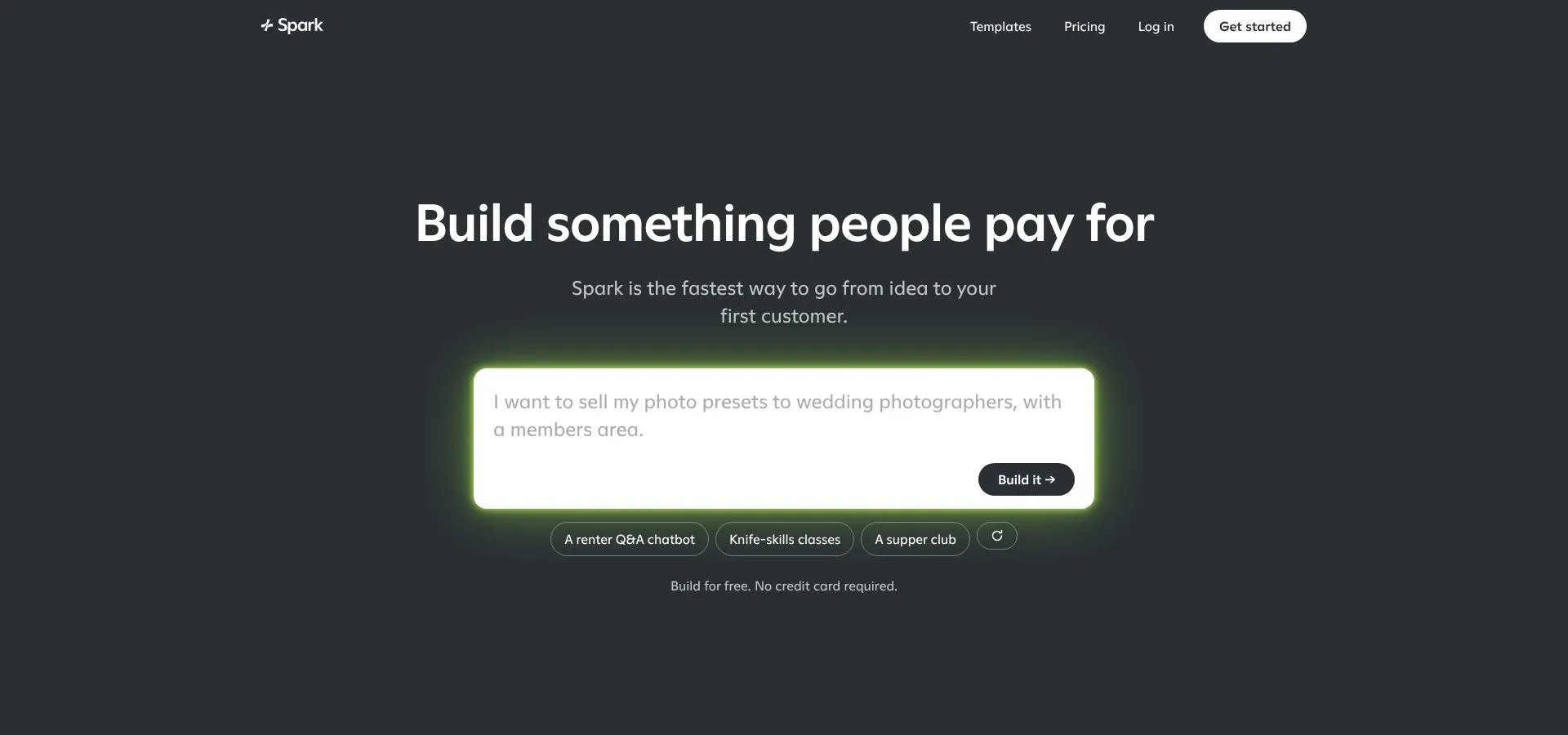
A craft-fair fan already trusts your work; they just need a memorable link and a fast checkout. Spark gives you both in minutes. Describe your brand in chat, and Spark assembles pages, photos, and payments with no coding or template wrangling. You can build for free without a credit card and publish on a spark.site address the same day; Spark (https://spark.site) walks you through the whole flow.
Pricing (verified November 7, 2026)
- Free: $0 with one-time $15 Build and $15 App credits; publish on a spark.site address with a Built with Spark badge (no payments)
- Starter plan: $25 a month + 10 percent of each sale
- Pro plan: $200 a month + 5 percent of each sale
Stripe processing fees apply on top; at roughly $3,500 in monthly sales, Pro becomes cheaper than Starter.
Why repeat buyers like it
- One branded URL keeps customers out of fee-heavy marketplaces.
- Payments run through your own Stripe account.
Keep in mind
- Spark brings no marketplace traffic, so promote your link on booth signs, receipts, and newsletters.
Share a single QR code that points to yourname.spark.site and turn fair-day goodwill into revenue you fully control.
2. Square Online: the smooth hand-off from booth to browser
If you already swipe cards with a Square reader, opening a Square Online (squareup.com) store feels like flipping a switch: the same catalog, inventory numbers, and customer profiles flow from your point-of-sale app straight into a branded website.
Pricing (verified November 7, 2026)
- Free plan: 3.3 percent + 30 ¢ per online card payment, no monthly fee
- Plus and Premium: monthly plans that lower the online rate to 2.9 percent + 30 ¢
Watch-outs before you publish
- Automated campaigns (birthday offers, win-back messages to lapsed customers) are not on the Free plan; budget for a paid plan if email marketing is central to your growth.
- Square Online is not a marketplace; you still need to drive traffic from QR codes, social posts, or ads.
3. Shopify: the workhorse for a brand ready to scale
When spreadsheets and ad-hoc plug-ins start creaking, many makers graduate to Shopify (shopify.com). Its tightly knit system (storefront, POS hardware, inventory, discounts, abandoned-cart emails, and customer segments) lives in one dashboard.
Pricing (verified November 7, 2026)
- Basic plan: 29 dollars a month when billed annually
- Online orders: 2.9 percent + 30 ¢ via Shopify Payments
- Other gateways: add a 2 percent surcharge
Trade-off to know
Shopify supplies tools, not traffic. On our $50 order example, Etsy’s stacked fees are roughly $3.45 higher, so just nine such orders a month offset Basic’s subscription, but only if you can bring that traffic yourself.
4. Big Cartel: lean, artist-friendly, and cost-controlled
If your catalog tops out at a dozen prints or a few one-of-a-kind jewelry pieces, Big Cartel (bigcartel.com) keeps overhead razor-thin.
Pricing (verified November 7, 2026)
- Gold: a free, limited plan; pay only Stripe or PayPal processing (about 2.9 percent + 30 ¢ in the United States)
- Platinum: 15 dollars a month after a seven-day free trial
- Diamond: 30 dollars a month
All tiers carry the same zero-percent Big Cartel commission.
Limits to note
- Abandoned-cart recovery, scheduled product drops, and Zapier connections live only on the 30-dollar Diamond tier.
Best marketplaces for finding new handmade buyers.
When shoppers have not met you yet, they start where millions already browse. Built-in discovery can justify a higher fee, but only if the channel matches your product and production capacity.
5. Etsy: the heavyweight for handmade search
Etsy (etsy.com) still owns the phrase “I bought it from a maker online.”
Pricing (verified November 7, 2026)
- Listing fee: 0.20 dollar per item
- Transaction fee: 6.5 percent of the item price and shipping
- Payment processing (U.S.): roughly 3 percent + 0.25 dollar
On a 50-dollar mug, that stack removes about 5.20 dollars before ads.
Where it stumbles for repeat customers
- Layered fees pile up on big or low-margin items
- Limited marketing rights keep you from adding order emails to a newsletter without explicit consent
- Crowded search and rising ad costs push many sellers toward paid listings
6. MakerPlace by Michaels: a craft-centric stage still finding its audience
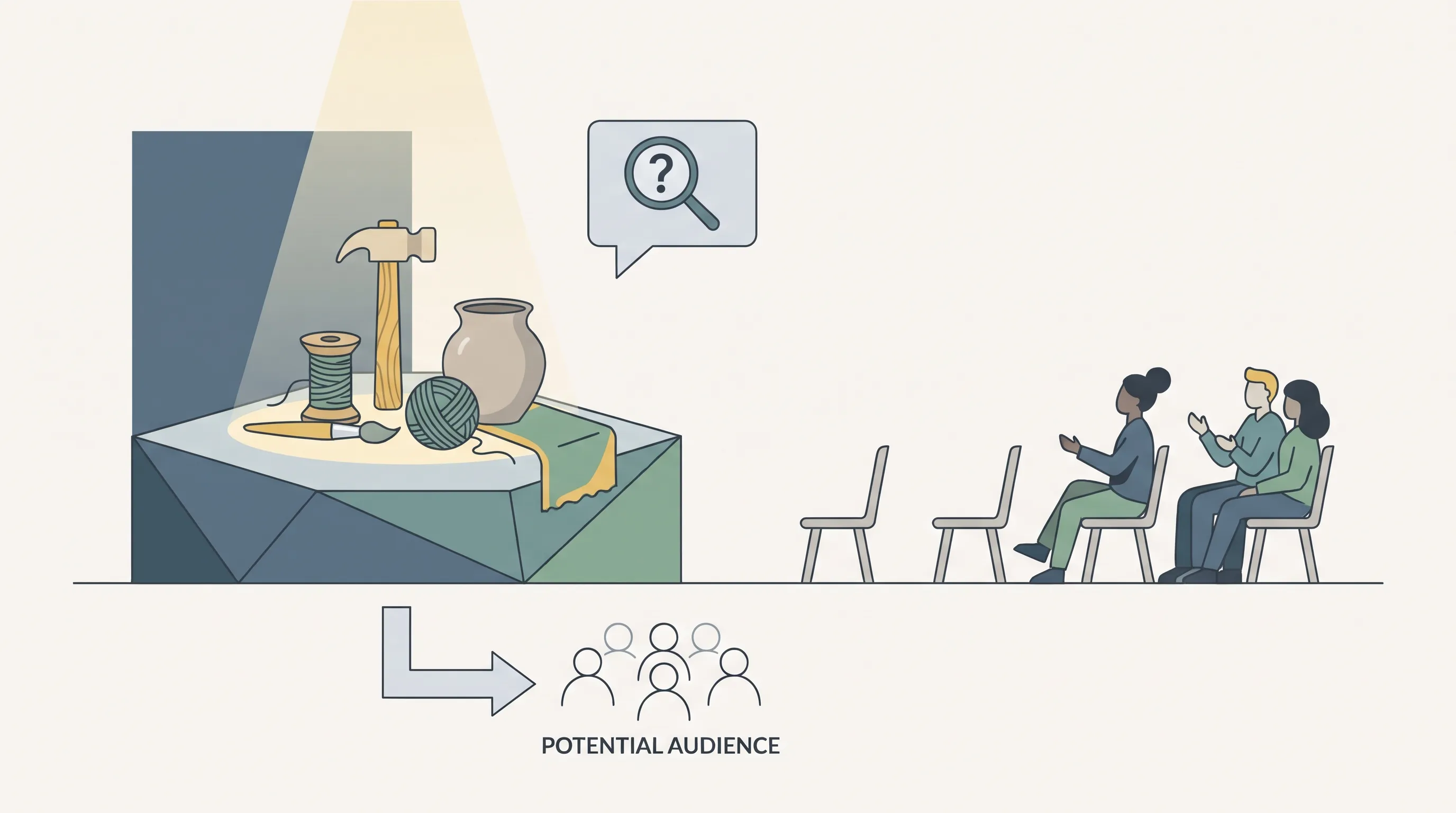
Michaels knows crafters, and in 2023 the chain turned that retail heritage into MakerPlace (michaels.com/makerplace), a handmade marketplace for makers.
Pricing (verified November 7, 2026)
- Standard plan: 4 percent commission + 3 percent processing + 0.20-dollar flat fee
- Premium plan: 2 percent commission (after 500 dollars in annual Michaels-supply purchases) + the same processing and flat fee
On a 50-dollar candle, the Standard stack totals roughly 3.70 dollars.
Watch-outs
- A younger marketplace, so expect less search traffic than Etsy.
- No built-in POS for in-person sales, meaning another system at markets.
7. Amazon Handmade: checkout trust that comes at a price
Amazon’s Prime-ready checkout feels familiar to millions of shoppers, and Amazon Handmade (amazon.com/handmade) lets you tap that trust without listing beside factory goods; every item passes a handmade application first.
Pricing (verified November 7, 2026)
- Professional selling plan fee (39.99 dollars a month) is waived after Handmade approval
- Referral fee: 15 percent of the item price
Ship orders yourself or use Fulfillment by Amazon; storage and pick-pack fees apply on top of the referral cut.
8. TikTok Shop: turn process videos into instant sales
If your making videos already attract comments like “Where can I buy this?”, TikTok Shop (shop.tiktok.com) places the buy button right under the clip. A viewer taps the yellow cart, checks out inside the app, and you receive the order before the glaze has cooled.
Pricing (verified November 7, 2026)
- Referral fee: a percentage of each completed order, set by category in TikTok Shop Seller Center (check the current US rate before you price)
- Creator-affiliate commissions are optional and set by you
Where it tests makers
- Constant video production can crowd out studio hours.
- Creator commissions can quickly outweigh the platform’s own referral fee.
9. eBay: the global bazaar for one-of-a-kind treasures
Search almost any quirky phrase (say, hand-blown glass octopus) and an eBay (ebay.com) listing often appears near the top. That evergreen search visibility is eBay’s superpower: collectors and nostalgia shoppers scour its pages daily for pieces they cannot find anywhere else.
Pricing (verified November 7, 2026)
- Most craft categories: 13.6 percent of the total order + 0.40 dollar once the sale tops ten dollars
- First 250 listings each month: no listing fee
Best use case
Unique, collectible, or discontinued pieces that do not fit standard retail SKUs: think experimental glazes, artist proofs, or last-run fabrics. List those rarities on eBay, then route repeat buyers to your own site for made-to-order work that commands steadier prices.
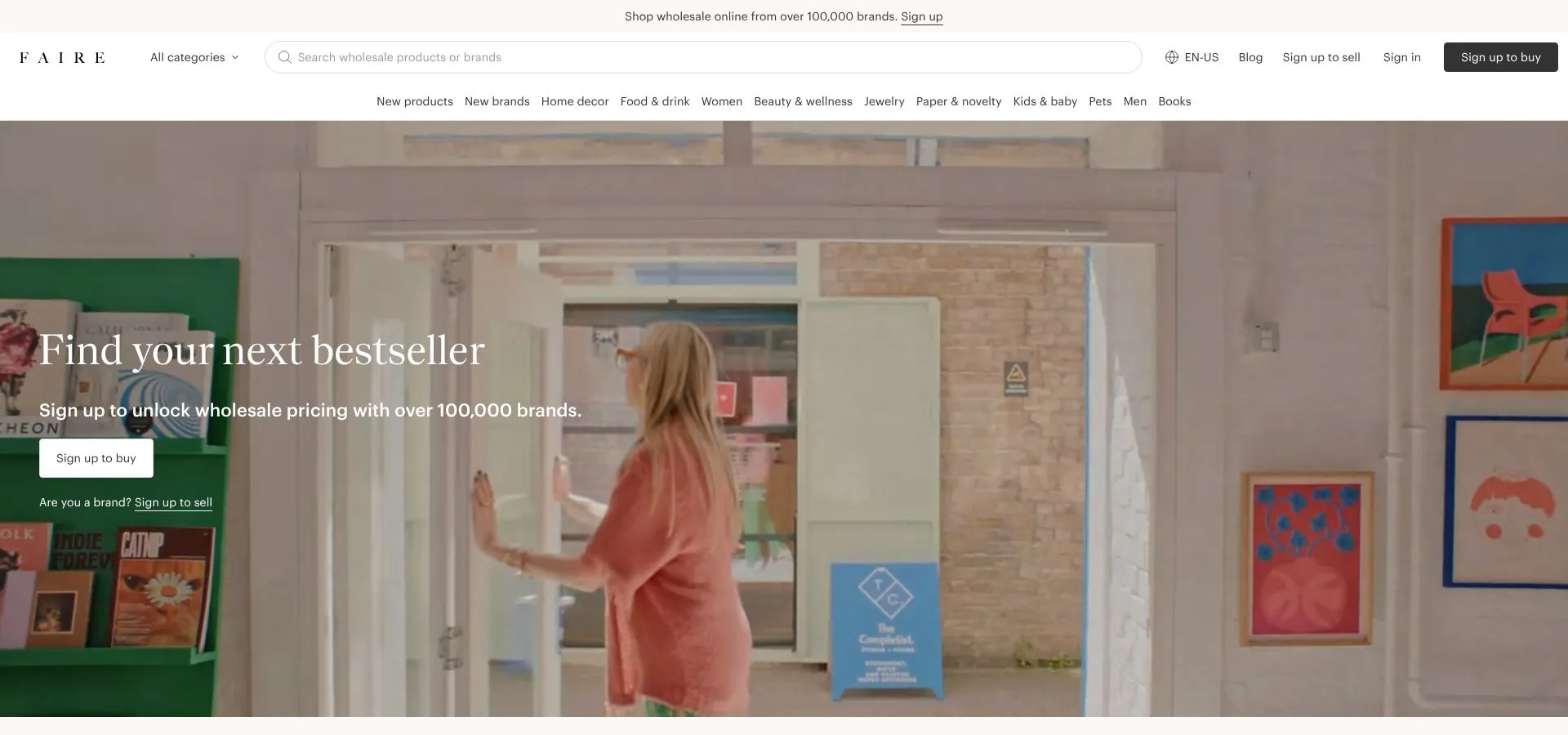
10. Faire: commission-free reorders for your favorite boutiques.
Retailers visit trade shows because they want to handle the product and meet the maker. Faire (faire.com) recreates that handshake online, matching independent brands with independent stores.
Pricing (verified November 7, 2026)
- Marketplace orders: 15 percent commission + 10-dollar first-order fee
- Faire Direct: 0 percent commission on orders from retailers you bring to Faire yourself
Trade-offs to price into every carton
- Wholesale pricing compresses margin; run the math on materials and labor before accepting a big opening order.
- Retailers you acquire through the Faire marketplace remain on the 15 percent tier, so build relationships quickly and migrate them to Faire Direct QR codes you control.
11. Artisans Cooperative: a marketplace the makers actually own.
Artisans Cooperative (artisans.coop) is a member-owned marketplace that keeps handmade sales in the hands of the people who craft the goods.
Pricing (verified November 7, 2026)
- Non-member: 12 percent platform fee + 3.49 percent + 0.49-dollar payment charge
- Supporter (cash stake or activity points): 9.5 percent + the same processing fee
- Artisan member: 8 percent + the same processing fee
There are no listing fees, so you can test new product lines at no upfront cost.
What the fees look like on the same $50 order.
Platform pricing pages toss numbers everywhere, so let’s level the field. Picture a single $50 online sale (shipping and tax not included, no ads or coupons) and compare only the platform cut plus standard payment processing.
On that order, Etsy’s stack comes to about $5.20, MakerPlace Standard about $3.70, Square Online’s Free plan $1.95, and Shopify Payments $1.75 plus the plan. Spark adds its 10 percent (Starter) or 5 percent (Pro) sales fee on top of Stripe processing, in exchange for a store you fully own.
Equal fees never guarantee equal sales: marketplaces bundle traffic and trust into their percentage, while owned stores trade lower fees for the job of driving buyers yourself. Add shipping, ads, creator commissions, and your time before you set a final price.
Choose a platform based on the buyer already in front of you.
If they held your work in person, send them to a direct storefront such as Spark, Square Online, Shopify, or Big Cartel. If they found you online, start with a discovery marketplace; for retailers, use Faire.
One focused destination beats five half-built stores. Launch the single channel that best matches how buyers currently discover you, then add the next channel only when inventory, cash flow, and head space allow.
Conclusion
The best place to sell handmade work shifts the moment a stranger becomes a fan, so this guide is organised around the buyer journey rather than a single ranking.
Fans who already know you belong on a direct storefront such as Spark; strangers are easier to reach on a marketplace that earns its cut.
Pick one home base and, if discovery remains a hurdle, one marketplace. Price products with the full fee stack, tag every QR link, and follow up quickly. Done well, those small steps convert casual compliments into permission-based revenue long after the tent comes down.